The User Condition: Between Agency and Behavior
What are the conditions for the computer user to gain agency, namely, being able to escape the automatisms embedded in digital platforms? What is their horizon of autonomy within software programmed by somebody else, whose logic is conveniently ossified and mostly made inaccessible?
“To know the world one must construct it.”
A World of Things
As humans, when we are born we are thrown into a world. This world is shaped by things made by other humans before us. These things are what relate and separate people at the same time. Not only we contemplate them, but we use these things and fabricate more of them. In this world of things, we labor, work and act. The labor we perform is a private process for subsistence that doesn’t result in a lasting product. Through work, we fabricate durable things. And then we act: we do things that lead to new beginnings: we give birth, we engage with politics, we quit our job. One could arrange these activities according to a scale of behavior: labor is pure behavior, work can be seen as a modulation of behavior, action is interruption of behavior. Action is what breaks the “fateful automatism of sheer happening”. This is, in a nutshell, Hannah Arendt’s depiction of the human condition.
Let’s apply this model to computers. If an alternative world is anywhere to be found, that is inside the computer, since the computer has the ability not only, like other media, to represent things, but to simulate those things, and simulate other media as well. Joanne McNeil points out that “metaphors get clunky when we talk about the internet” because the internet, a network of networks of computers, is fundamentally manifold and diverse. But for the sake of the argument, let’s employ a metaphor anyway. Individual applications, websites, apps and online platforms are a bit like the things that populate a metropolis: whole neighborhoods, monuments, public squares, shopping malls, factories, offices, private studios, abandoned construction sites, workshops, gardens—both walled and not. This analogy emerged clearly at the inception of the web, but it became less evident after the spread of mobile devices. Again McNeil: “As smartphones blurred organizational boundaries of online and offline worlds, spatial metaphors lost favor. How could we talk about the internet as a place when we’re checking it on the go, with mobile hardware offering turn-by-turn directions form a car cup holder or stuffed in a jacked pocket?”. Nowadays, the internet might feel less like a world, but it maintains the “worldly” feature of producing the more or less intelligible conditions of users. In fact, with and within networked computers, users perform all three kinds of activity identified by Arendt: they perform repetitive labor, they fabricate things, and, potentially, they act, that is, they produce new beginnings by escaping prescribed paths, by creating new ones, by not doing what they are expected to or what they’ve always been doing.
Agency and Automatism
Among the three types of activity identified by Hannah Arendt, action is the broadest, and the most vague: is taking a shortcut on the way to the supermarket a break from the “fateful automatism of sheer happening”? Does the freshly released operating system coincide with “a new beginning”? Hard to say. And yet, I find “action”, with its negative anti-behavioral connotation, a more useful concept than the one generally used to characterize positively one’s degree of autonomy: agency. Agency is meant to measure someone’s or something’s “capacity, condition, or state of acting or of exerting power”. All good, but how do we measure this if not by assessing the very power of changing direction, of producing a fork in path. A planet that suddenly escapes its predetermined orbit would appear “agential” to us, or even endowed with intent. An action is basically a choice, and agency measures the capacity of making choices. No choice, on the contrary, is behavior. The addict has little agency because their choice to interrupt their toxic behavior exists, but is tremendously difficult. In short, I propose to define agency as the capacity for action, which is in turn the ability to interrupt behavior.
Here’s a platform-related example. We can postulate a shortage of user agency within most dominant social media. What limits the agency of a user, namely, their ability to stop using such platforms, is a combination of addictive techniques and societal pressures. It’s hard to block the dopamine-induced automatism of scrolling, and maybe it’s even harder to delete your account when all your friends and colleagues assume you have one. In this case, low agency takes the form of a lock-in. If agency means choice, the choice we can call authentic is not to be on Facebook (or WeChat, if you will).
While this is a pragmatic understanding of agency, we shouldn’t forget that it is also a very reductive one: it doesn’t take into account the clash of agencies at play in any system, both human and non-human ones.
Users and Non-Users
We call “user” the person who operates a computer. But is “use” the most fitting category to describe such an activity? Pretty generic, isn’t it? New media theorist Lev Manovich briefly argued that “user” is just a convenient term to indicate someone who can be considered, depending on the specific occasion, a player, a gamer, a musician, etc. This terminological variety derives from the fact, originally stated by computer pioneer Alan Kay, that the computer is a metamedium, namely, a medium capable of simulate all other media. What else can we say about the user? In The Interface Effect Alexander Galloway points out en passant that one of the main software dichotomies is that of the user versus the programmer, the latter being the one who acts and the former being the one who’s acted upon. For Olia Lialina, the user condition is a reminder of the presence of a system programmed by someone else. Benjamin Bratton clarifies: “in practice, the User is not a type of creature but a category of agents; it is a position within a system without which it has no role or essential identity […] the User is both an initiator and an outcome.”
Paul Dourish and Christine Satchell recognize that the user is a discursive formation aimed at articulating the relationship between humans and machines. However, they consider it too narrow, as interaction does not only include forms of use, but also forms of non-use, such as withdrawal, disinterest, boycott, resistance, etc. With our definition of agency in mind (the ability to interrupt behavior and break automatisms), we might come to a surprising conclusion: within a certain system, the non-user is the one who possesses maximum agency, more than the standard user, the power user, and maybe even more than the hacker. To a certain extent, this shouldn’t disconcert us too much, as often with the ability to refuse concides with power. Often, the very possibility of breaking a behavior or not acquiring it in the first place, betrays a certain privilege. We can think, for instance, of Big Tech CEOS that fill the agenda of their kids with activities to keep them away from social media.
Ants
In her essay, Olia Lialina points out that the user preexisted computers as we understand them today. The user existed in the mind of people imagining what computational machines would look like and how they would relate to humans. These people were already consciously dealing with issues of agency, action and behavior. A distinction that can be mapped to notions of action and behavior has to do with creative and repetitive thought, the latter being prone to mechanization. Such distinction can be traced back to Vannevar Bush.
In 1960, J. R. Licklider, anticipating one of the cores of Ivan Illich’s critique, noticed how often automation meant that people would be there to help the machine rather than be helped by it. A bureaucratic “substitution of ends” would take place. In fact, automation was and is often semi-automation, thus falling short of its goal. This semi-automated scenario merely produces a “mechanically extended men”. The opposite model is what Licklider called “Man-Computer Symbiosis”, a truly “cooperative interaction between men and electronic computers”. The Mechanically Extended Man is a behaviorist model because decisions, which precede actions, are taken by the machine. Man-Computer Symbiosis is a bit more complicated: agency seems to reside in the evolving feedback loop between user and computer. Human-computer Symbiosis would “enable men and computers to cooperate in making decisions and controlling complex situations without inflexible dependence on predetermined programs”. Behavior, understood here as clerical, routinizable work would be left to computers, while creative activity, which implies various levels of decision making, would be the domain of both.
Alan Kay’s pioneering work on interfaces was guided by the idea that the computer should be a medium rather than a vehicle, its function not pre-established (like that of the car or the television) but reformulable by the user (like in the case of paper and clay). For Kay, the computer had to be a general-purpose device. He also elaborated a notion of computer literacy which would include the ability to read the contents a medium (the tools and materials generated by others) but also the ability to write in a medium. Writing on the computer medium would not only include the production of materials, but also of tools. That is for Kay authentic computer literacy: “In print writing, the tools you generate are rhetorical; they demonstrate and convince. In computer writing, the tools you generate are processes; they simulate and decide.”
More recently, Shan Carter and Michael Nielsen introduced the concept of “artificial intelligence augmentation”, namely, the use of AI systems to augment intelligence. Instead of limiting the use of AI to “cognitive outsourcing” (AI as an oracle, able to solve some large class of problems with better-than-human performance), AI would be a tool for “cognitive transformation” (changing the operations and representations we use to think).
Through the decades, user agency meant freedom from predetermined behavior, ability to program the machine instead of being programmed by it, decision making, cooperation, break from repetition, functional autonomy. This values and the concerns deriving from their limitation were already present since the inception of the science that propelled the development of computers. One of most present fears of Norbert Wiener, the founding father of cybernetics, was fascism. With this word he didn’t refer to the charismatic type of power in place during historical dictatorships. He meant something more subtle and encompassing. For Wiener, fascism meant “the inhuman use of human beings”, a predetermined world, a world without choice, a world without agency. Here’s how he describes it in 1950:
In the ant community, each worker performs its proper functions. There may be a separate caste of soldiers. Certain highly specialized individuals perform the functions of king and queen. If man were to adopt this community as a pattern, he would live in a fascist state, in which ideally each individual is conditioned from birth for his proper occupation: in which rulers are perpetually rulers, soldiers perpetually soldiers, the peasant is never more than a peasant, and the worker is doomed to be a worker.
Basically, the fascism so much dreaded by Wiener was feudalism.
The image depicted by Wiener is that of a world without choice, where use -as the performance on one’s predetermined function, becomes pure labor, and non-use which is actually the only form of use is impossible. Fascism as the impossibility of non use.
Impersonal Computing
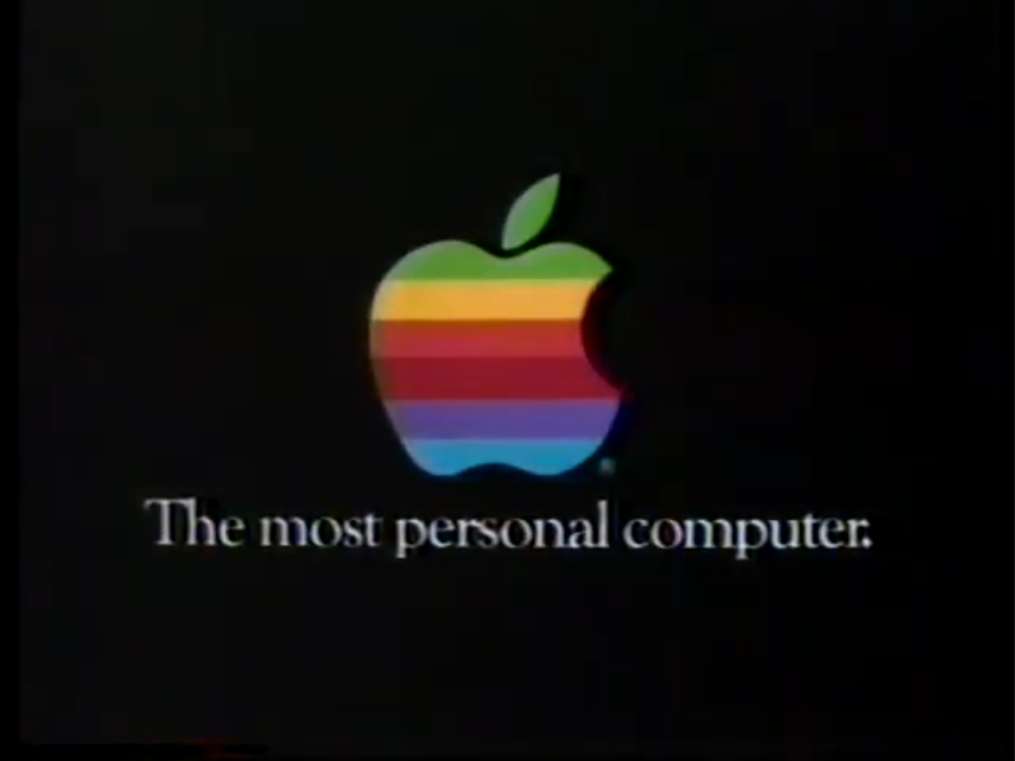
In the 80’s, Apple came up with a cheery, Coca Cola-like ad with people of all ages from all around the world using their machine for the most different purposes. The commercial ended with a promising slogan: “the most personal computer”. A few decades afterwards, Alan Kay, who was among the first to envision computers as personal devices, was not impressed with the state of computers in general, and with those of Apple in particular.
For Kay, a truly personal computer would encourage full read-write literacy.Through the decades, however Apple seemed to go in a different direction: cultivating an allure around computers as lifestyle accessories, like a pair of sneakers. In a sense, it fulfilled more than other companies the consumers’ urge to individualize themselves. Let’s not, though, look down on the accessory value of a device and the sense of belonging it creates. It should be enough to go to any hackerspace to recognize a similar logic at play, but with a Lenovo (or more recently a Dell) in place of a Mac.
And yet, Apple’s computer-as-accessory actively reduced read-write literacy. Apple placed creativity and “genius” at the surface of preconfigured software. Using Kay’s terminology, Apple’s creativity was relegated to the production of materials: a song composed in GarageBand, a funny effect applied to a selfie with Photo Booth. What kind of computer literacy is this? Counterintuitively, what is a form of writing within a software vehicle, is often a form of reading the computer medium. We only write the computer medium when we do not simply generate materials, but tools. A term coined by Robert Pfaller in a different context seems to fit here: interpassivity. Don’t get me wrong, not all medium writing needs to happen on an old-style terminal, without the aid of a graphical interface. Writing the computer medium is also designing a macro in Excel or assembling an animation in Scratch.
Then, the new millennium came and mobile devices with it. At this point, the hiatus between reading and writing grew dramatically. In 2007 the iPhone was released. In 2010, The iPad was launched. Its main features didn’t just have to to do with not writing the computer medium, but not writing at all: among them, browsing the web, watching videos, listening to music, playing games, reading ebooks. The hard keyboard, the “way to escape pre-programmed paths” according to Dragan Espenschied, disappeared from smartphones. Devices had to be jailbroken. Software was compartimentalized into apps. Screens became small and interfaces lost their complexities to fit them. A “rule of thumb” was established. Paraphrasing Kay again, simple things didn’t stay simple, complex things became less possible.
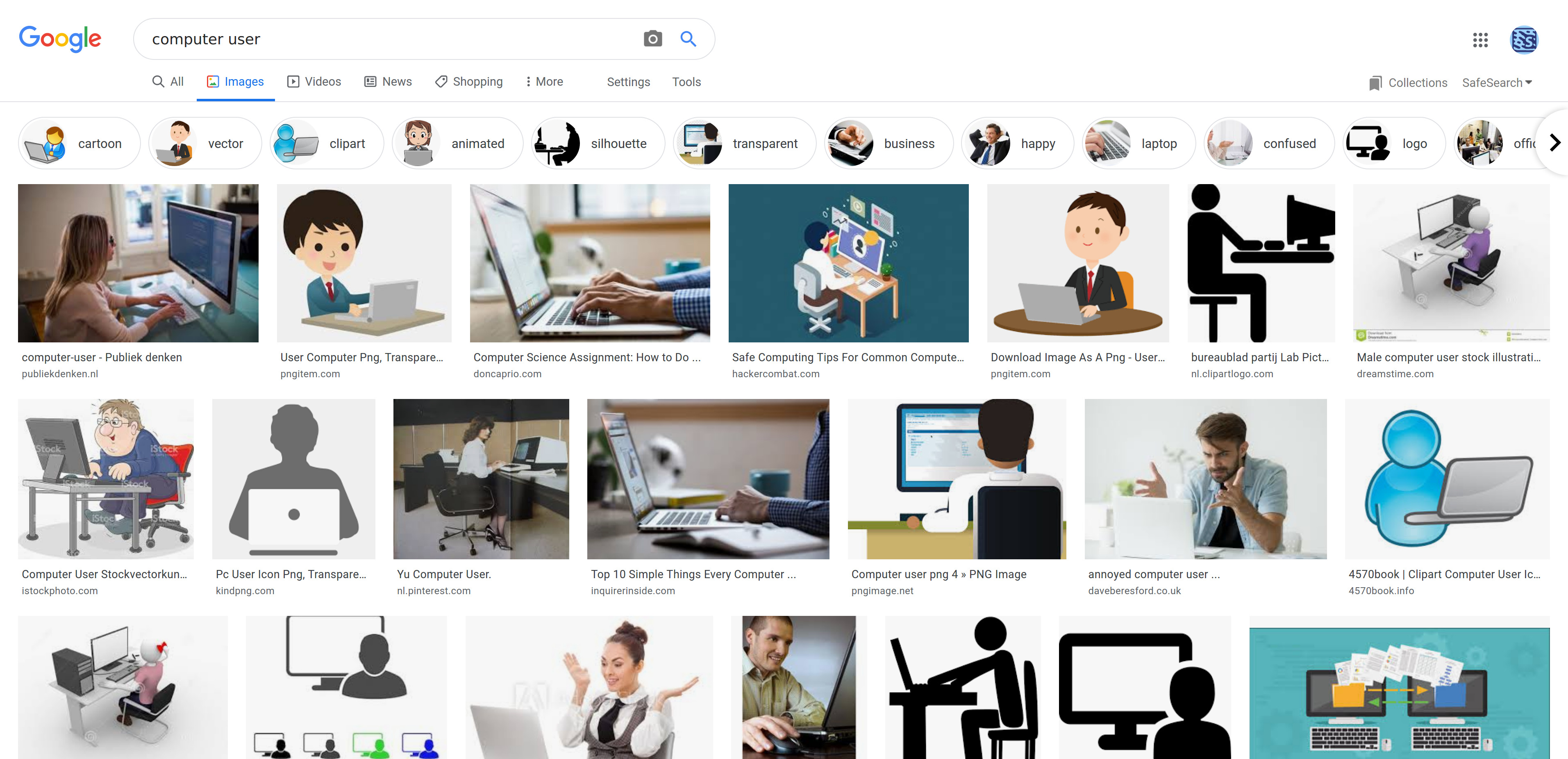
Google Images confirms that we are still anchored to pre-mobile idea of computers, a sort of skeuomorphism of the imagination. We think desktops or, at most, laptops. Instead, we should think of smartphones. In 2013, Michael J. Saylor started noticing a shift: “currently people ask, ‘Why do i need a tablet computer or an app-phone [that’s how he calls a smartphone] to access the Internet if I already own a much more powerful laptop computer?’. Before long the question will be, ‘Why do I need a laptop computer if I have a mobile computer that I use in every aspects of my daily life?’” If we are to believe the CNBC, he was right. Their recent title was “Nearly three quarters of the world will use just their smartphones to access the internet by 2025”. Right now, in the US, a person is more likely to possess a mobile phone than a desktop computer (81% vs 74% in the US according to the Pew Center) and I suspect that globally the discrepancy is higher. A person’s first encounter with a computer will soon be with a tablet or mobile phone rather than with a PC. And it’s not just kids: the first computer my aunt used in her life is he smartphone. The PC world is turning into a Mobile-first world.
There is, finally, another way in which the personal in personal computers has mutated. The personal became personalized. In the past, the personal involved not just the possession of a device, but also one’s own know-how, a savoir faire that a user developed for themselves. A basic example: organizing one’s music collection. That rich, intricate system of directories and filenames each of us came individually up with. Such know-how, big or small, is what allows us to build, or more frequently rebuild, our little shelter within a computer. Our home. When the personal becomes personalized, the knowledge of the user’s preferences and behavior is first registered by the system, and then made alien to the user themelves. There is one music collection and it’s called iTunes, Spotify, YouTube Music. Oh, and it’s also a mall where advertising forms the elevator music. Deprived of their savoir faire, the users receive an experience which is tailored on them, but they don’t know exactly how. Why exactly is our social media timeline ordered? We don’t know, but we know it’s based on our prior behavior. Why exactly does the autosuggest present us with that very word? We assume it’s a combination of factors, but we don’t which ones.
Let’s call it impersonal computing (or … ), shall we? Its features: computer accessorization at the expense of an authentic read-write literacy, mobile-first asphyxia, dispossession of an intimate know-how. A know-how that, we must admit, is never fully annihilated: tactical techniques emerge in the cracks: small hacks, bugs that become features, eclectic worksflows. The everyday life of Lialina’s Turing-Complete user is still rich. That said, we can’t ignore the trend. In an age in which people are urged to “learn to code” for economic survival, computers are commonly used less as a medium than as a vehicle. The utopia of a classless computer world turned out to be exactly that, a utopia. There are users and there are coders.